Introduction
A family reunion map video can show more than where people travelled from. It can connect the places where family stories happened with the people who remember them.
One person might send a message from the city where they live now. Another might share a photograph from an old gathering. Someone unable to attend can still contribute a place and a memory.
The main editing decision is to keep those meanings clear. A current home, the location of an old photograph, and the reunion venue are three different kinds of place. Give each one a role instead of treating them as interchangeable pins.
Choose the film's central idea
Start with one sentence that describes the gift you want the video to give the family.
For example: “These are the places our family calls home,” “Here is what we remember about gathering together,” or “Different places, one shared weekend.”
The first idea emphasizes people and their current lives. The second emphasizes memory. The third connects distance with the reunion itself.
You can combine them, but choose one as the main thread. Otherwise, the film may move from a childhood story to a present-day greeting to a travel route without explaining the change.
This guide focuses on the finished reunion film. For help with the collection stage, read how to create a family reunion memory-video invitation.
Pick a map structure that matches the story
There are three useful ways to organize the geography.
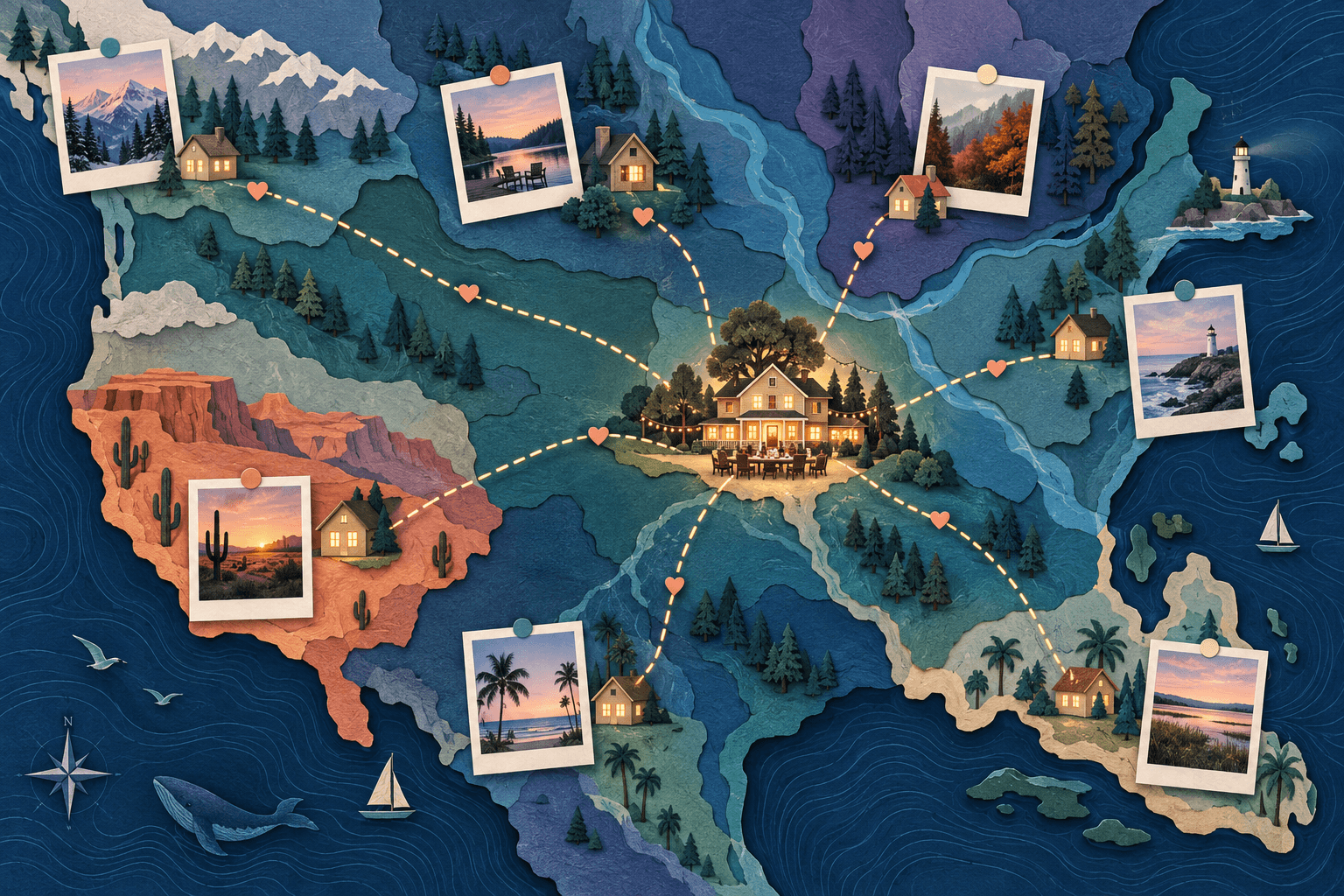
Many places, one gathering. Show each contributor's city or region, then return to the reunion location. This makes separate contributions feel connected without implying that everyone followed one shared route.
One place, many memories. Stay around a familiar area and introduce the stories attached to it. This can work for a reunion connected to a hometown or a place where gatherings happened over the years.
A sequence of family chapters. Move through meaningful locations in a stated order, such as an earlier gathering, a more recent chapter, and the present reunion. Use dates or period labels when needed to avoid suggesting that different generations were in the same place at the same time.
The map should clarify relationships between stories, not attempt to prove family history. Describe uncertain recollections as recollections rather than established facts.
Ask for a small, specific contribution
A clear request makes the material easier to edit and gives quieter contributors a way to participate.
Ask for a short greeting, one photo they have permission to share, and a city or general area. Let people contribute a written message instead of appearing on camera.
Here is an original invitation you can adapt:
“We are making a short map video for the reunion. Please send one photo or a brief message, the city or area you would like shown, and one sentence about a family memory. You can also send text only. We plan to show the video at the reunion and share it with the family afterward. Please tell us about anything you would prefer not to include.”
Add a real deadline in the invitation you send. Leave enough time to check names, review permissions, and fix missing context before the event.
AlbumMap's FAQ describes inviting people to contribute through a shared link or QR code without requiring a guest account or app. The invitation should still explain the audience and the type of material you want.
Give contributors prompts that produce stories
“Say something about the family” is a broad request. A smaller question can lead to a more concrete memory.
Try prompts such as “What do you remember about the place where we used to gather?” or “Which ordinary family tradition would you like someone younger to know about?”
For people joining remotely, ask “What is one thing you wish you could do with us at the reunion?” For a photo contribution, ask “Who is in this picture, where was it taken, and what happened just before or after it?”
Do not ask everyone the same question when their connections to the family are different. Include partners, chosen family, and people whose memories do not fit a neat generational timeline.
Participation should be an invitation, not a test of belonging.
Separate current locations from old-photo locations
Use simple labels such as “Message from…” and “Remembered in…” when the distinction matters.
For example, a relative speaking from their current city might be describing a photograph taken somewhere else. Placing that photograph on their current-home pin without explanation could confuse the story.
Create a small planning table before editing:
| Contribution | Location to display | Label needed |
|---|---|---|
| Present-day greeting | The contributor's chosen city or region | “Hello from…” |
| Old gathering photo | Where the event happened, when known | Place and approximate period |
| Remote reunion message | The sender's chosen area | “Joining us from…” |
| Closing reunion scene | The gathering location | Reunion title or date |
Use broader areas when exact locations are private or uncertain. Do not guess a historical place just to fill a pin.
Build a running time from the contributions
Decide on the available attention before collecting long speeches. A film for a seated viewing can be different from a short background loop during a busy meal.
As an illustrative calculation, twelve messages averaging eight seconds give ninety-six seconds of speaking time. Add a twenty-second opening, twenty seconds of map transitions, and a fifteen-second ending, and the rough cut is about two and a half minutes. Photo pauses or longer stories will add to that.
The calculation is a planning example, not a rule for the perfect reunion length. Measure the actual material and revise the structure.
When the film becomes too long, group related memories or make a longer private edition. Avoid solving the problem by making every person speak unnaturally fast.
Alternate people and places
A repeated pattern can help the audience follow a large group: introduce the place, show the contribution, then use a short map transition to the next chapter.
Do not make every transition equally elaborate. The people should receive more attention than the camera movement between them.
Open with a message that establishes the theme, not necessarily the oldest photograph or the first upload. In the middle, group material by a shared topic: gatherings, food, everyday traditions, or messages from relatives who cannot be there.
End with something shared, such as a current group photo or a sentence that includes both in-person and remote participants. The ending should feel like a gathering, not the last name on a list.
Check permission and readability before the event
Ask contributors to confirm names and any captions attached to their stories. Do not silently change the meaning of a message to make it fit the theme.
For children, involve the appropriate parent or guardian in decisions about recording and sharing. Let anyone opt out of a public or wider-family version without needing to explain why.
Provide captions or a text version for important speech. W3C's transcript guidance explains how a descriptive transcript can include essential visual details alongside the words being spoken.
Use music only where you have the necessary permission, and keep it from overpowering voices. A meaningful sentence should not be lost under the soundtrack.
Rehearse the actual playback
Test the exported file on the device and screen you plan to use. Check that the text is readable from the seating area and that the quietest contributor can be heard.
Keep a local copy of the final video rather than relying only on an unfamiliar internet connection. Also keep the editable project and the original contributions separately so corrections do not require starting over.
If the audience will be moving around, consider showing the main film at a designated moment. A message-led video may lose its meaning when most people cannot hear it.
Make the distance part of the connection
A reunion video does not need to include every family fact. It needs a clear theme, enough context to follow the stories, and room for people to recognize one another.
Explore AlbumMap to build a place-based family story, and use the reunion invitation guide to begin gathering the contributions.
Helpful answers
Frequently asked questions
Can people who cannot attend still be included?
Yes. Invite a photo, written memory, or recorded greeting. State where it will be shown and shared so they can make an informed choice.
Should every person get the same amount of screen time?
A broadly balanced structure is a useful starting point, but identical timing is not always necessary. Prioritize inclusion and understandable messages rather than a rigid count of seconds.
What can I do with a photo whose date or location is uncertain?
Use an honest approximate label or leave the uncertain detail out. Do not turn a guess into a factual map caption.
How is this different from a standard reunion slideshow?
The map gives each contribution geographic context and can connect people living in different places. The memories still need to carry the emotional meaning.