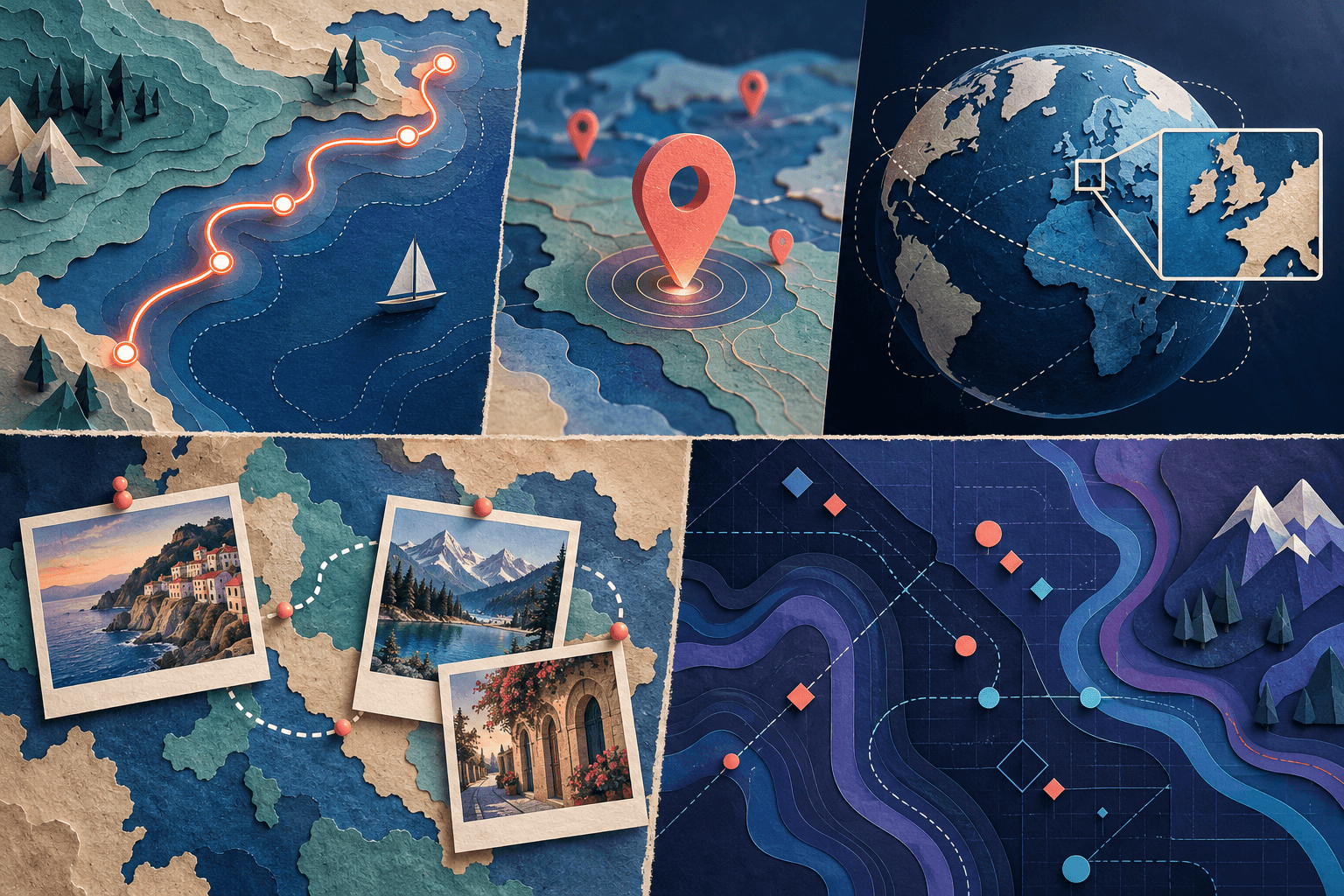
Introduction
A looping map animation should return to its opening state without an obvious jump. Matching the first and last camera positions is only part of the job. Route lines, labels, photographs, lighting, and sound also need a planned transition across the seam.
Begin by deciding how the animation will come back. A one-way zoom into a destination rarely becomes a natural loop just because a player repeats it.
For a location-based map scene, explore AlbumMap. Plan any loop-specific compositing or finishing in an editor with the controls you need; this guide does not assume that every map maker has a one-click seamless-loop feature.
Choose a loop structure before creating the route
There are three practical starting points.
Return to the overview
Open on a calm map, reveal a short journey, pause at the destination, and return to the same overview. Reset temporary elements during that return so the next repetition begins cleanly.
This is a useful structure for a route story because it gives the viewer a complete action and a clear resting state. Keep the return brief enough that it does not feel like an unrelated second journey.
Use a repeating camera cycle
A camera movement can follow a repeating cycle, such as a full orbit around a fixed subject. Every relevant visual state needs to repeat as well. A globe that completes a rotation will still jump if its labels, clouds, lighting, or foreground cards have changed by the end.
MathWorks' explanation of seamless animation loops demonstrates the value of motion that repeats continuously. For a map, apply that idea to the whole composition, not just one rotating object.
Reverse the movement
A forward-and-back sequence can create a loop when the reversal is intentional. Use it for a restrained camera approach or an abstract map background.
It is less suitable when reversing changes the meaning. A plane travelling backwards, a route disappearing in reverse, or a person moving unnaturally can make the loop look like an editing mistake. Do not use a reversal to imply a real return journey that did not happen.
Match the full opening state
Compare the two sides of the seam systematically. The camera needs a compatible position, direction, zoom, and tilt. The visible route must have the same state, and labels must not appear or vanish unexpectedly.
Check photographs and cards separately. A map background may loop perfectly while a photo panel jumps to a different size or opacity. Give every temporary element an exit before the reset or design its motion as a complete repeating cycle.
Also inspect any time-dependent layers. A changing clock, counter, sun position, or pulsing marker can reveal the seam even when the map looks unchanged.
The practical question is: could the next frame after the ending belong naturally to the beginning?
Match motion, not just position
Two frames can look identical while the movement between them still feels wrong. A camera that arrives quickly and restarts slowly changes its speed at the seam. A marker can reverse direction without a visual jump in position but still create a noticeable jerk.
For a loop with a resting overview, let the camera settle before the end and begin the next cycle from rest. For continuous movement, make the direction and pace carry through the seam.
Here is a simple frame-planning example. A 12-second sequence at 30 frames per second contains 360 frames. For continuous periodic motion, sample one cycle across those 360 frames rather than appending an extra duplicate of the first frame at the end. A deliberate hold is different: use one when a pause is part of the design.
This is a timing illustration, not a required frame rate or duration for every project.
Build a 12-second route loop
Use this original storyboard for a simple overview-return loop:
| Time | Action | Loop consideration |
|---|---|---|
| 0–2 seconds | Hold the opening overview | Establish the same resting state used at the end |
| 2–5 seconds | Reveal a short route | Keep labels and camera changes restrained |
| 5–7 seconds | Pause at the destination | Show one brief piece of supporting media |
| 7–10 seconds | Return toward the overview | Remove temporary cards and reset the route treatment |
| 10–12 seconds | Hold the restored opening view | Allow the next cycle to begin from the same state |
The exact reset depends on your tools. You might fade temporary route elements during a transition, return through a neutral view, or assemble the closing section in another editor. Do not assume that all of those controls exist in the map generator itself.
Check whether the final and opening holds create an overly long pause when combined. They sit next to each other during playback, even though they are at opposite ends of the editing timeline.
Use crossfades carefully
A short crossfade can soften a reset, but it does not automatically produce a seamless loop. Different camera views may overlap into double coastlines, duplicate labels, or ghosted route lines.
Use the fade only when the overlapping states are visually compatible. A quiet background can tolerate a blend more easily than a dense scene with moving text.
Test the seam in motion at normal speed and slowly. When the blend is noticeable, try matching the camera more closely, simplifying the frame, or switching to an intentional pause-and-restart structure.
A clear repeat can be better than an almost-seamless transition that constantly draws attention to itself.
Plan the sound separately
For a decorative website background, a silent loop is often the simplest editorial choice. For a social clip, test the music and sound effects across the boundary rather than only inside the timeline.
Avoid ending on half a spoken sentence or restarting a sound with a sharp click. Match the audio phrasing to the loop, choose a clean ending, or use a controlled fade when appropriate. Keep the necessary rights for any music or recorded sound.
Watch the video several times in a row. A sound that feels subtle once may become distracting on repetition.
Test the loop where it will be used
Place several copies of the exported clip back to back. Watch at least three joins. This reveals problems that are easy to miss when you only scrub between the first and last still frames.
For websites, provide a static alternative and suitable playback controls. W3C's Pause, Stop, Hide guidance addresses automatically moving content that lasts more than five seconds and appears alongside other content, subject to its stated exceptions. Do not equate a visually smooth loop with an accessible implementation.
Also test the real page layout. A route that looks attractive on its own may compete with a heading or make a button difficult to see.
Design the return before the beginning
A good loop has a planned reset, not just an attractive opening. Build one short scene, solve the seam, and only then add detail. For the underlying location story, create a map video in AlbumMap.
Helpful answers
Frequently asked questions
Do the first and last frames need to be identical?
The repeating state must connect correctly. For continuous motion, an extra duplicated endpoint can introduce a small pause. For a loop designed around a still hold, matching resting frames can be appropriate.
Can I simply reverse a map video?
Only when the reversal makes visual and narrative sense. Check vehicles, route reveals, text, and any embedded footage rather than reversing the whole composition automatically.
Does a looping player make any video seamless?
No. The player repeats the file; it does not repair mismatched camera positions, labels, route states, or audio.
Is a moving map always suitable behind website text?
No. Test legibility and distraction, offer a calmer alternative, and keep essential information available without depending on the animation.