Introduction
A food travel vlog becomes more personal when it follows the meals you remember and explains why they mattered. Choose a clear theme, map a small set of food stops, and pair each place with the dish, your reaction, and one detail about the moment. The result can be a tasting diary rather than another unsupported claim to have found the best food in a city.
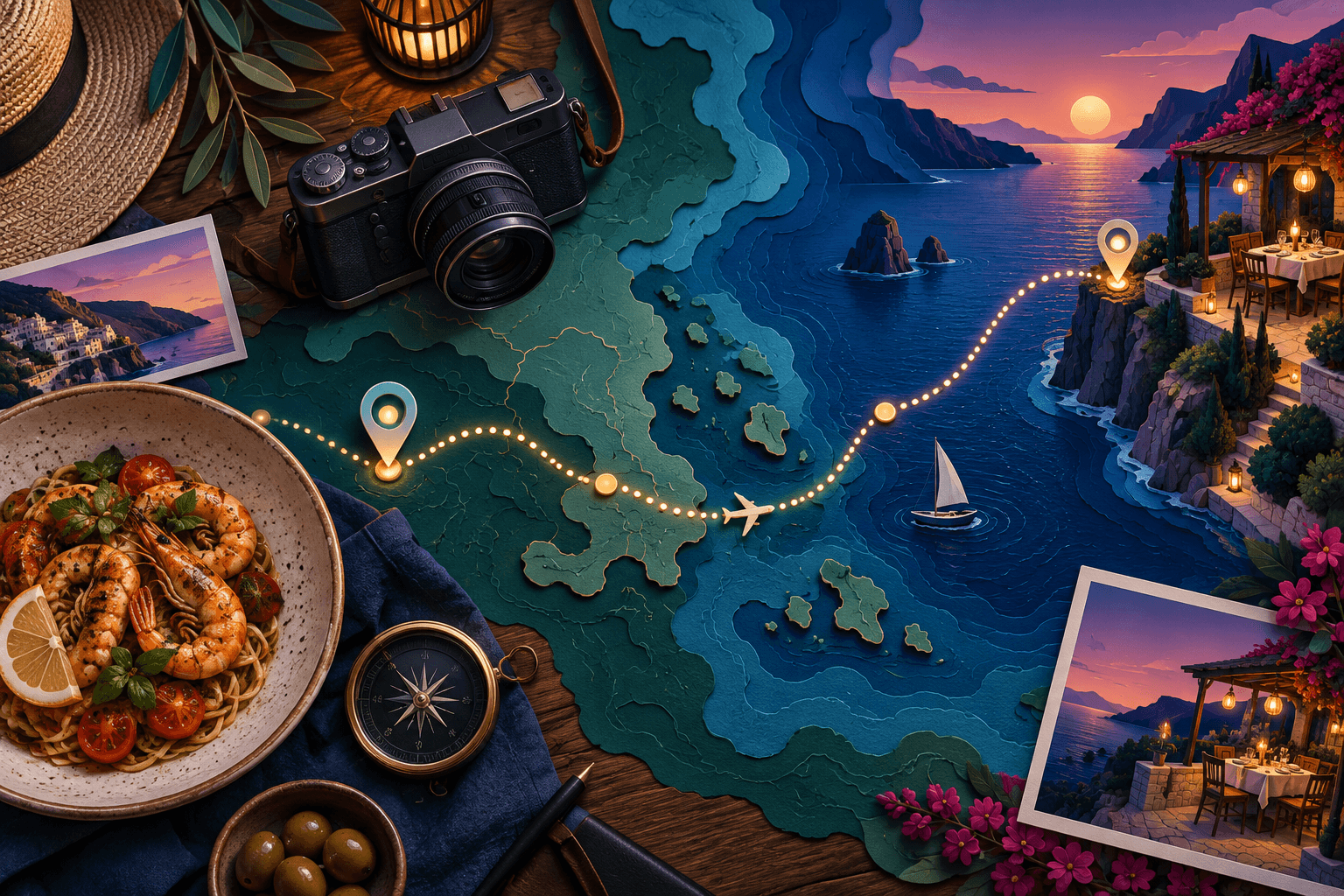
The map should connect the meals into a journey. It does not need to become a restaurant directory, booking guide, or nutritional review. Start with the experience you can describe from your own visit.
Explore the location-based creator workflow in AlbumMap, then use the three-stop structure below to organise your material.
Give the food travel vlog one organising idea
Pick a theme before selecting the most attractive shots. Useful themes include the breakfasts that started each day, meals suggested by travel companions, or the stops that changed your original plan.
A narrow theme helps you compare like with like. “Three meals we kept talking about” allows a personal selection. “The best restaurants in the country” implies a much wider basis than a holiday's worth of visits.
You can also follow a repeated question: what did you order, what surprised you, and what would bring you back? The answers create consistency without making every scene sound identical.
Keep inherited family dishes in a separate family recipe story video. That format follows people and kitchens over time; this one records your own experience of meals during a trip.
Capture four kinds of material at each stop
The place
Record a clear public-facing detail such as a sign, entrance, or street scene when filming is permitted. This helps identify the stop later and gives the food a setting.
Confirm the branch or location rather than relying on the restaurant name alone. A business can have more than one venue. If the video is a personal memory rather than a public recommendation, a neighbourhood or town label may be sufficient.
The dish
Get a stable view before adding movement. Show the portion as it arrived, a useful close-up, or an action that explains the texture. Avoid spending so long filming that the meal stops being enjoyable for the people with you.
Use the dish name supplied by the venue, and check the spelling. Do not infer ingredients or preparation methods from appearance when you have not confirmed them.
The reaction
Describe something specific: the contrast of textures, the unexpected portion, or the dish a friend persuaded you to try. “I liked this more than I expected” is a personal reaction. “Everyone will love this” is a claim about other people.
A short reaction recorded after the meal can work better than a forced performance at the table. You can use it as narration over the food and location images.
The memory
Save one sentence about the occasion. Perhaps you were sheltering from rain, celebrating the end of a long walk, or returning to a place a companion remembered.
That sentence is what turns a meal clip into a chapter of a trip. It also helps when the dish itself is ordinary but the moment was not.
Keep a tasting note, not an invented review score
Use a small record for each stop. The example below is fictional and demonstrates a method rather than recommending a business.
| Field | Example note |
|---|---|
| Location | A café near the town centre; exact branch checked separately |
| Visit context | The morning after our longest day out |
| What we ordered | Dish name copied from the menu |
| Personal observation | The crisp topping was the detail I remembered |
| Story detail | Everyone went quiet for the first few bites |
| Footage | Entrance, plate, table photo, and a short reflection |
| Publishing check | Companions approve the table photo; no payment details visible |
Record prices only when you actually need them, and attach the visit date. A travel keepsake does not need current opening hours or cost comparisons to be useful.
Photo locations can help you investigate a forgotten stop, but they are not proof on their own. Google Photos explains that a location may come from a camera, manual entry, or an estimate. Check your notes and the venue details before placing the pin.
A 60-second three-stop storyboard
Use this as a suggested first cut. The timing is a creative choice, not a social-platform limit.
| Time | Scene | Job of the scene |
|---|---|---|
| 0–6 seconds | An overview with three place markers | Introduce the theme: three meals from one trip |
| 6–20 seconds | First stop, dish, and personal line | Set the pattern and explain the first memory |
| 20–34 seconds | Second stop with a different kind of detail | Add contrast rather than repeat the first scene |
| 34–48 seconds | Third stop and the strongest reflection | Give the story a final meaningful meal |
| 48–60 seconds | Return to the overview and a closing image | Explain what links the three stops |
Within each stop, let the map introduce the place briefly, then give most of the time to the meal and memory. Use a city-level transition for widely separated stops; use a local view for a compact neighbourhood story.
Do not imply that the connecting line is a recommended walking route. An illustrated sequence tells viewers where your chapters happened. It does not establish access, transport, or travel time.
Use narration that adds something to the image
An original opening could be: “I thought I would remember this trip by its views. These are the tables I keep remembering instead.”
A chapter line might be: “We nearly skipped this stop. It became the meal everyone mentioned on the way home.” The camera can show the food while the narration explains why it matters.
Avoid repeating the same reaction at every stop. Use the travel journal prompts to find a different detail for each meal: a choice, a conversation, a surprise, or a memory.
Respect the people behind the food
Ask before filming staff at close range, recording a conversation, or showing a private preparation area. Follow the venue's filming rules and do not obstruct service for a shot.
Separate your personal experience from broad statements about a cuisine or culture. One meal can illustrate what you tasted; it cannot establish what an entire community eats or how a dish originated.
If a meal was gifted or the video involves a commercial relationship, make that relationship clear rather than presenting the account as an ordinary self-funded visit. Keep this information easy for viewers to notice.
Map the meals that have a reason to stay
Choose three stops and write one honest sentence about each. Turn those locations and approved images into an AlbumMap story that preserves the meal, the company, and the moment together.
Helpful answers
Frequently asked questions
Can I make a food travel vlog using only photos?
Yes. Use a place image, a food photograph, and a short caption for each stop. A map can supply the movement while your written or spoken details provide the story.
Do I need to rank the meals?
No. A theme such as memorable breakfasts or meals shared with friends is enough. Rankings are optional and should not imply broader testing than you actually performed.
What happens when I cannot remember a venue?
Use your own notes, photographs, and visit records to investigate. If you cannot confirm it, keep the location broad and say so rather than pinning a guess to a specific business.
Can the video include several cities?
Yes, provided the theme still connects the stops. Keep the location changes clear and avoid spending more time travelling across the map than telling the food stories.