Introduction
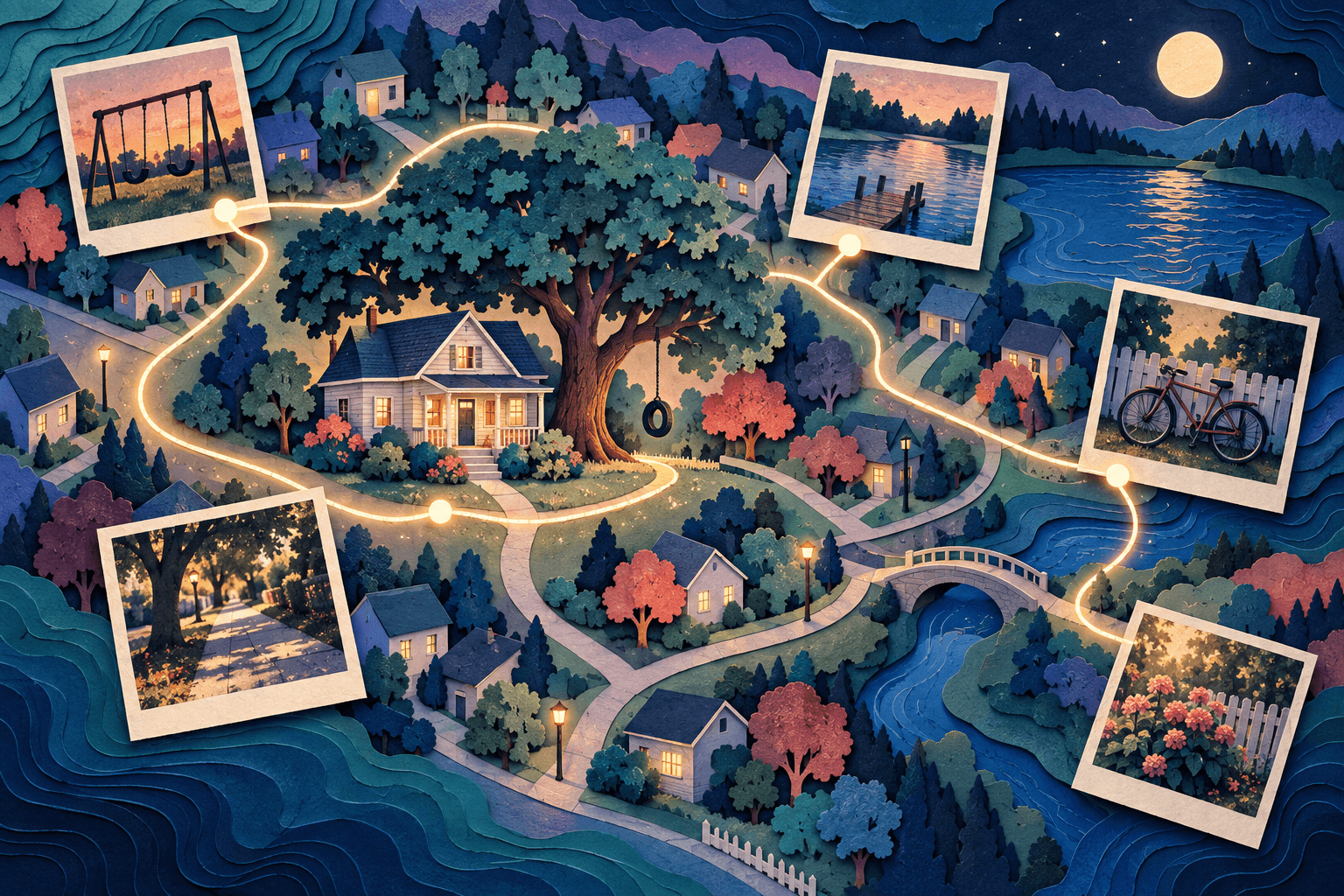
A childhood memory map connects the places that shaped your early world with the stories you associate with them. To turn it into a video, choose a small area, select a few meaningful stops, and give each one a photograph, object, or spoken memory. The finished film can be a personal memoir without becoming a complete history of the neighbourhood.
You do not need to travel back or find a photograph of every building. The subject is your remembered experience. Be clear about what you remember, what you have checked, and what remains uncertain.
Explore a personal map film with AlbumMap, then begin by sketching the area as you recall it before consulting a present-day map.
Start smaller than your whole hometown
Choose an area that held a recognisable part of your life: the streets around a former home, a relative's neighbourhood, or the route between a few familiar public places.
A small frame makes room for detail. A film about five meaningful corners can say more than a rapid tour of every address where you lived.
Write a working title that describes the viewpoint. “The streets I knew at ten” is different from “A history of our town.” The first invites a personal memory; the second implies a wider factual account that would need different research.
Draw the remembered map before the accurate one
On paper, mark the places that come to mind first. Add the names your family used, even if they were informal: “the shop with the noisy door” or “the corner where we waited.”
This sketch is a memory aid, not the final geographic reference. Its value is revealing which places mattered enough to remain in your mind.
Next, check the locations you plan to show. Keep your informal name as a caption when useful, but do not silently replace an uncertain building with a nearby one. A broader label is better than false precision.
A present-day map can locate the story, but it does not automatically reconstruct the streets or boundaries as they existed during your childhood. Say that the base map is contemporary when the distinction matters.
Choose five stops with different roles
Try to give each place a distinct function in the memoir. This fictional framework keeps the film from becoming five versions of the same anecdote.
| Role | A possible memory | A visual alternative when no old photo exists |
|---|---|---|
| Belonging | The place where someone expected to see you | A familiar object or a recorded recollection |
| Independence | The first errand you completed alone | A simple map scene and a short caption |
| Friendship | A regular meeting place | An approved photograph of the people involved |
| Routine | A stop you passed almost every week | A personal drawing, labelled as a memory sketch |
| Perspective | A place you understand differently now | A new voice recording over the broad location |
These roles are prompts, not a checklist everyone must complete. Leave out a place that feels too private or painful to revisit. A memoir does not become more honest by exposing more than you want to share.
Give every stop a small scene
Describe an action, an object, and a person or feeling. “We used to go to that shop” is a starting point. “I practised what to ask for all the way there” gives the viewer an experience.
An original narration example might be: “This corner looked much farther away when I was allowed to walk there alone. I remember the errand more clearly than the shop itself.”
The map can hold on the broad area while a caption identifies the approximate time. A childhood photograph of you can be relevant even if it was not taken at that exact corner, as long as the edit does not claim otherwise.
For memories centred on a dish and a family kitchen, the family recipe story video offers a more focused structure.
Work honestly with missing images
Missing footage gives you several options. Use the storyteller's voice, a surviving object, an original drawing, or a map with a short description. These can all support a memory without pretending to show a scene you cannot document.
Keep new illustrations clearly separate from archival photographs. If a drawing represents how a place felt, label it as a recollection or illustration. Do not present generated or reconstructed imagery as evidence of how the neighbourhood actually looked.
Avoid filling every visual gap with unrelated stock footage. A street that merely resembles the one you remember can confuse viewers about the location. A simple, accurate map hold is often the better choice.
Keep other people's memories distinct from yours
Invite a sibling or friend to react to one stop, then label whose memory is being heard. You may recall different details. That difference can enrich the film without needing a single definitive version.
Try a prompt such as, “When I name this place, what comes back to you first?” It is less leading than asking them to confirm your own account.
Give contributors a chance to review their clips. Remove identifying details they do not want shared, including current addresses or private information about other residents. A person remembered fondly still has a say in whether their image appears in a public film.
Build the video around a return, not a comparison
Open with one place that establishes the childhood world. Move through the selected stops, then return to the opening location with a different reflection.
For example, the first line might describe how large the neighbourhood felt. The closing line might explain how small the mapped area looks now, while acknowledging how much life happened inside it.
This is not a requirement to make matching old-and-new photographs. The return is narrative: the viewer understands the same place differently after hearing the stories.
A two- or three-minute first version gives you room to hear a voice and pause on a photograph. Treat that as a creative starting point, not a fixed rule.
Save the evidence and the memories separately
Keep original photos, untrimmed recordings, source notes, and the final edit in clearly named folders. Record who identified a place and whether the identification is certain or approximate.
The Library of Congress's personal digital-photo preservation guidance recommends organising photographs, documenting them, and keeping copies in different places. The film should be one way to enjoy the collection, not its only surviving form.
A moving announcement video can share a new chapter separately. Let the childhood film remain about the world you remember, rather than turning its ending into an unrelated relocation update.
Map the place as you experienced it
Start with the corner, object, or routine that you can describe most clearly. Build a childhood map story in AlbumMap that preserves those details while leaving uncertainty visible and private information out.
Helpful answers
Frequently asked questions
Can I make a childhood memory map without revisiting?
Yes. Use checked broad locations, surviving photos, objects, and recorded memories. Be transparent about missing details and do not imply that you recently visited a place when you did not.
What happens when a building no longer exists?
Keep the memory tied to a verified location or a qualified area. A present-day map can act as a locator, but should not be presented as a reconstruction of the former building.
Should I include exact former home addresses?
Use only the precision the story needs. A broad neighbourhood marker can preserve the memory without identifying current residents or exposing family information.
Can several people narrate the same map?
Yes. Identify the speakers and give each contribution a purpose. Contrasting recollections can be valuable when they remain clearly attributed rather than blended into an invented shared memory.