80th Birthday Video Ideas That Preserve Family Stories
An 80th birthday video can do more than gather cheerful greetings. It can preserve the birthday person’s voice, family stories, familiar sayings, and memories tied to important places. The best version still feels like a birthday gift. It celebrates the person now instead of treating their life like a finished history. You do not need expert equipment or a formal documentary plan. Start with a few good questions, meaningful photos, and people who can help tell the story.
Why Family Stories Belong in an 80th Birthday Video
Eight decades can hold stories that never made it into a photo album. A picture may show a house, wedding, shop, or holiday. It rarely explains what happened just before the photograph or why that day still matters. A recorded voice can add those missing details.
This gift also lets the birthday person take part as a storyteller. Messages about them are valuable, but their own memories give the film another layer. Record their laughter, expressions, favorite phrases, and way of explaining family events.
Keep the mood balanced. Include hard-earned lessons when the person wants to share them, but leave room for jokes, recent interests, and future plans. The film should feel warm and alive, not like a memorial.
Choose the Story You Want to Preserve
Do not try to cover every year. A complete life history would be too large for one birthday film. Choose a clear purpose that fits the person and the time available.
You might focus on how the family changed across eight decades. You could preserve stories behind old photographs, follow important places, record recipes and traditions, or collect lessons from the birthday person. Another option is to ask several people for different versions of the same family stories.
Write your purpose in one sentence. For example: “We are making a birthday film that records Mum’s stories about the people and places that shaped our family.” Use that sentence when inviting contributors.
8 Ideas for a Story-Rich 80th Birthday Video
1. Create eight short life chapters. Use one section for each decade, but do not force equal coverage. Choose one photograph, voice, place, or turning point for each chapter. Recent decades deserve space too.
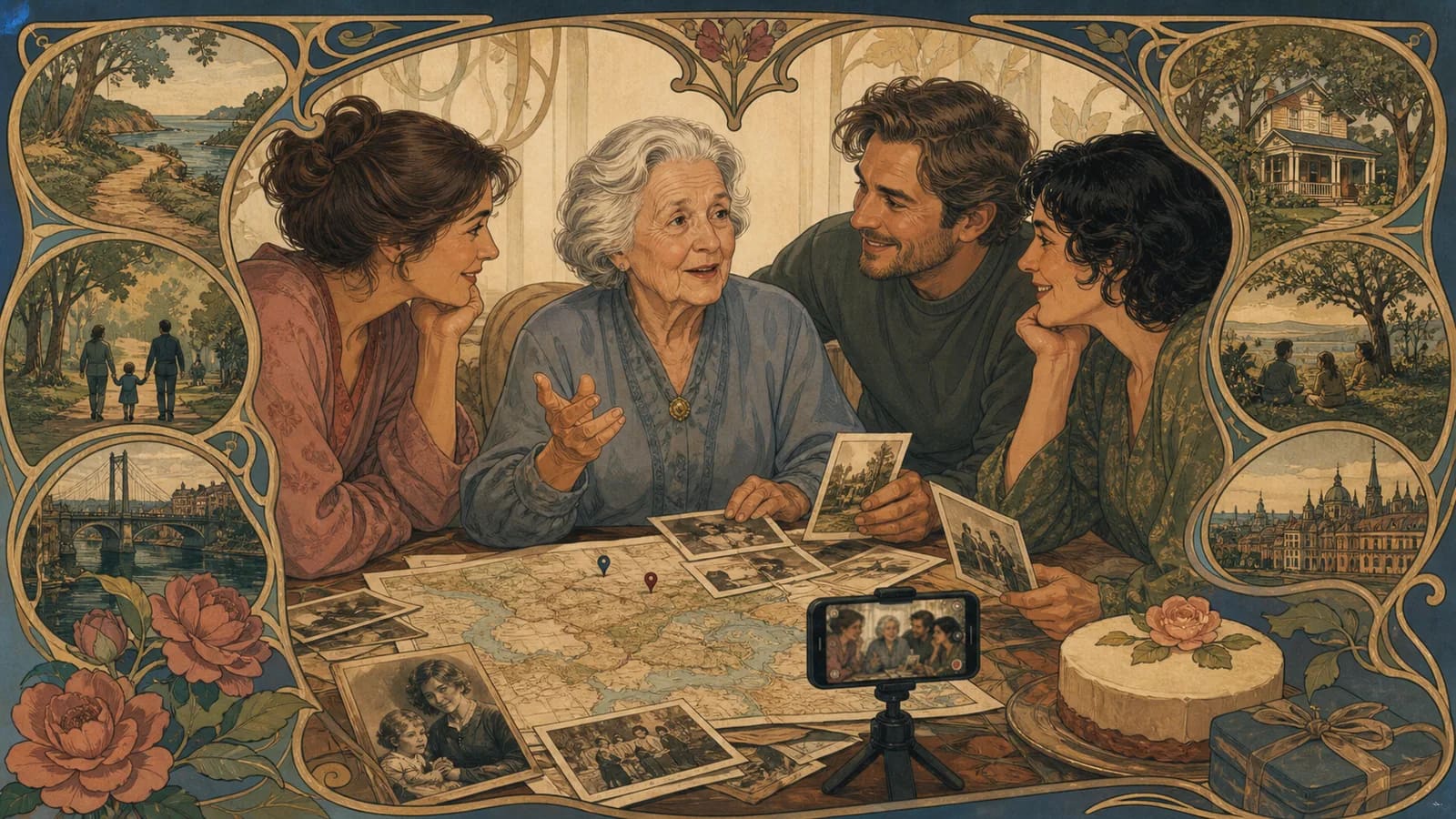
2. Record a photo-table interview. Sit together with a small group of photographs. Ask what happened, who was present, and what the camera missed. Let the birthday person choose which stories belong in the film.
3. Follow a map of meaningful places. Begin with a childhood home or hometown. Continue through schools, workplaces, family homes, community spaces, and favorite trips. Each stop can introduce a photograph, short clip, or message.
4. Preserve a family recipe or tradition. Record the birthday person cooking, preparing for a holiday, tending a garden, fixing something, or explaining a family routine. Ask where the tradition began and how it changed.
5. Collect lessons and familiar sayings. Children, grandchildren, friends, and former coworkers can explain what they learned. Pair each lesson with the birthday person’s own account or a related memory.
6. Tell one story through several voices. Ask siblings, cousins, or old friends to remember the same event. Small differences can be funny and revealing. Edit the versions together without deciding that one person must be right.
7. Pair past and present. Show an old home beside its current view, a childhood hobby that continues today, or a family tradition shared with a new generation. This makes the story about continuity, not only nostalgia.
8. End with the next chapter. Ask what the birthday person still wants to learn, visit, make, or enjoy. Invite relatives to share a plan they hope to experience together.
Ask Permission Before Recording Personal Memories
Explain the project before a planned interview. A surprise collection of greetings can be lovely, but a life story interview needs trust. Let the birthday person decline a question, pause, or ask for part of the recording to be removed.
Some stories involve other people. Avoid sharing private health details, family conflicts, exact addresses, or painful events without clear permission. A story can be meaningful without revealing every detail.
Decide who will see the finished film. A private family viewing requires different choices from a public post. Ask contributors before placing their faces, children, homes, or personal stories online.
Use Photos and Objects as Gentle Memory Prompts
Open-ended questions can feel too broad. A photograph, letter, map, recipe card, tool, souvenir, or piece of music gives the conversation a clear starting point. Hold up one item and allow time for the story to develop.
Ask simple follow-up questions. “Where was this?” “Who took the photograph?” “What happened that day?” “What do you remember that is not shown?” “Why did you keep this?” These prompts invite details without testing anyone’s memory.
Do not correct dates during the recording unless accuracy is important to the story. Write uncertain dates as “around 1965” or “the early 1970s.” Another relative can add context later. The goal is to listen, not conduct a quiz.
Interview Prompts That Invite Real Stories
Begin with comfortable topics. Ask about a favorite childhood place, a family meal, a first job, or a person who made them laugh. Easy questions help the speaker settle into the conversation.
Useful prompts include: What did your neighborhood feel like? What family habit should continue? Which trip still makes you smile? What did your parents or grandparents teach you? What small moment changed your direction? What are you proud to see in the family today?
Ask one question at a time. Wait after the first answer because the next thought may contain the best detail. Avoid interrupting to improve the wording. Natural speech is part of what the family will want to remember.
If a question creates strain, move on. The speaker does not need to prove anything. A short, relaxed interview often preserves more warmth than a long session built around perfect dates and complete answers.
Invite Voices From Different Parts of Their Life
Make a list by chapter rather than family rank. Consider siblings, children, grandchildren, cousins, old friends, neighbors, former coworkers, community members, and people connected to hobbies or travel.
Ask each person to add one missing piece. A sibling might describe childhood. A coworker may remember quiet acts of support. A grandchild can explain how a tradition feels today. Different views keep the birthday video montage from becoming a line of repeated praise.
Offer choices to people who do not want to appear on camera. They can send a voice note, written message, photograph, scanned letter, or location with a short explanation. These items can appear between recorded clips.
Set a deadline at least one week before the reveal. Send one friendly reminder. Contact essential contributors directly instead of relying only on a large group chat.
Record Clear Video Without Making It Formal
A phone or tablet is enough. Choose a quiet room and place the speaker near a window or soft lamp. Rest the device on a stable surface. Keep water nearby and remove background sounds when possible.
Frame the speaker from about the chest upward. Look toward the camera lens during direct messages. During an interview, looking at the person asking questions may feel more natural.
Record short sessions if the speaker becomes tired. Several clips of five to ten minutes are easier to manage than one long interview. Leave a pause before and after every answer so the editor has room to make clean cuts.
Add captions when possible. Keep background music soft and avoid fast transitions, flashing effects, and tiny text. Test the finished video on the screen and speakers that will be used at the celebration.
Shape the Family Story Video With a Simple Plan
Open with a recent image and a warm welcome. This tells viewers that the film celebrates the person as they are today. Then introduce the theme in one or two sentences.
Arrange the middle by decade, topic, person, or place. Mix first-person interview clips with family messages, photographs, and short home videos. Let strong stories breathe. Simple cuts are often better than busy effects.
Trim repeated greetings while protecting each person’s specific detail. A focused film is easier to watch at a party. Longer interviews and unused stories can be saved as separate family files.
Close with gratitude and something forward-looking. A final family greeting can work well, but it should not erase the birthday person’s own voice. Consider ending with their answer to a hopeful question about the years ahead.
When a Map-Based Story Makes the Memories Clearer
A map is useful when places carry part of the story. A childhood street, first workplace, family home, meeting place, or favorite journey can explain how people and memories connect.
AlbumMap can bring shared photos, short videos, written messages, and locations into one map-based story. Family members in different places can each contribute a piece. The finished route can move through the locations that shaped eight decades.
Use only places that add meaning. Avoid filling the map with every address. A smaller set of well-explained locations will create a clearer journey. If place is not important to the story, a standard family history video may be the better choice.
Plan a Comfortable Birthday Reveal
Choose a viewing style that suits the recipient. A lively party screening may feel right for someone who enjoys attention. A quiet viewing with close family may be kinder for someone who prefers private moments.
Keep the first screening to a comfortable length. Pause if the birthday person wants to explain a photograph or answer a message. Those new comments can become valuable stories too, with permission.
Test the file, internet connection, volume, captions, and screen before the event. Keep a downloaded backup when possible. Give the recipient an easy way to watch the video again without solving a technical problem.
Save the Video So the Family Can Find It Later
Keep the final video, original interviews, scanned photographs, and a short file list in at least two safe places. Use clear filenames with names, topics, and approximate dates. Avoid leaving the only copy on one phone.
Write down who appears in older photographs. Record uncertain names or dates as uncertain rather than guessing. A small amount of context can make a file much more useful to future relatives.
Review sharing permissions before giving copies to a wider group. If you create a link or QR code, test it and include a normal web address as a backup. Check stored files from time to time so the gift remains usable.
Common Mistakes to Avoid
Do not make every clip about age. Avoid jokes about memory, health, or being old unless the recipient clearly enjoys them. Celebrate their character, relationships, and present life.
Do not push for painful stories because they seem dramatic. Let the speaker choose what belongs in a birthday gift. Respect pauses, boundaries, and requests to remove material.
Do not wait for perfect equipment or every invited person. A clear recording of three true stories can matter more than a polished film filled with vague greetings.
Do not focus only on the distant past. Include current routines, recent photographs, new family members, and plans for the future. The person’s story is still being written.
Examples You Can Copy
Copy-ready invitation for family and friends
Hi everyone! We are creating a birthday video for [Name] that will preserve family stories as well as birthday wishes. Please send a 30-to-60-second clip by [Date]. Share one memory, lesson, familiar saying, or story connected to a photo or place. Upload it here: [Link]. Please keep the project private until the birthday.
Copy-ready interview invitation
For your birthday, we would love to record a few stories in your own words. We can look through photos and talk for about 20 minutes at a time. You can skip any question and remove anything you do not want shared. The goal is a warm family gift, not a formal interview.
Copy-ready photo prompt
Please choose one photograph connected to [Name]. Tell us who appears in it, where it was taken, what happened that day, and why you still remember it. Details that are not visible in the picture are especially welcome.
Copy-ready place prompt
Choose one place that belongs in [Name]’s story. It could be a home, school, workplace, shop, park, town, or travel stop. Send a photo or short clip and explain what happened there or why the place still matters.
Copy-ready message from a grandchild
Happy 80th birthday, [Name]. One story I want our family to keep is [specific story]. It matters to me because [reason]. Thank you for teaching me [lesson or tradition]. I hope we can share [future plan] together.
Copy-ready contributor reminder
Friendly reminder that your story or birthday message for [Name] is due on [Date]. A natural phone recording is perfect. If video is difficult, you can send a voice note, written message, photograph, or meaningful location instead. Upload it here: [Link].
Copy-ready closing narration
These stories began in different years and places, but they all lead back to you. Thank you for the lessons, laughter, traditions, and care you have shared. Happy 80th birthday, [Name]. We are grateful for the memories behind us and ready for the ones still ahead.
Final Thoughts
The most valuable 80th birthday film is not always the longest or most polished. It is the one that sounds like the person and the family. Record their own voice, invite stories from different life chapters, and use photos or places to uncover details. Keep the process comfortable and respect what should remain private. When the memories stretch across homes, cities, workplaces, and journeys, AlbumMap can connect those locations with shared messages and media. The result can be both a warm birthday gift and a family record worth keeping.
Helpful answers
Frequently asked questions
- How long should an 80th birthday video be?
- A focused birthday edit of about 10 to 20 minutes works for many families. Keep most contributor clips under one minute. Save full interviews as separate files so valuable stories are not lost when the birthday version is shortened.
- What questions should I ask in an 80th birthday interview?
- Ask about people, places, traditions, work, travel, lessons, and small moments. Photos and objects can make questions easier. Ask what happened, who was present, what the camera missed, and why the memory still matters.
- How many family members should contribute?
- There is no required number. A few people with specific stories may create a stronger film than a large group sharing similar greetings. Invite voices from different life chapters and relationships.
- What if the birthday person does not remember exact dates?
- Do not turn the recording into a test. Use broad dates such as “the early 1970s” when needed. Another relative can add context later. Mark uncertain details as uncertain rather than guessing.
- How can someone contribute without appearing on camera?
- They can send a voice note, written message, scanned letter, photograph, drawing, or meaningful location. Add a short explanation so the contribution fits naturally into the story.
- Should the video be a surprise?
- Birthday messages can be collected as a surprise, but a personal interview should be discussed first. The storyteller should be able to skip questions, set limits, and approve sensitive material.
- How can I keep the video from feeling sad?
- Balance older memories with humor, current interests, recent photos, and future plans. Let the birthday person speak about what they enjoy now. End with something the family hopes to share next.
- When is a map-based video useful?
- Use a map when locations help explain the story. Homes, towns, schools, workplaces, and journeys can form clear chapters. If places do not add meaning, a simple birthday montage may work better.