Introduction
A good kindergarten graduation video starts before anyone records. It starts with an contributor invitation that answers the guest's basic questions.
The strongest card removes small reasons to wait. It names the task, gives an easy prompt, and shows one next step. A playful, gentle, and very simple style fits this event well.
Adults make the invite, but children watch the result. Keep each request short, avoid competition, and offer a text-only choice for families who do not want to record. This guide shows how to turn that idea into a card people can read and act on quickly.
A Complete Invitation Plan for the kindergarten graduation video
Start the guest list with parents, guardians, teachers, and close relatives. The purpose is to collect short, safe messages that young children can enjoy. Remove anyone who should not receive private details, then choose one organizer who can answer questions and track replies.
Build the first draft around this headline: “Send a little graduation cheer for [Child/Class Name].” Under it, explain that the video is for a young graduate or small class. Put the task on the next line so guests do not mistake your invitation for a normal event notice.
The visual plan is large shapes, bright school colors, and one instruction per line. Use that idea as a limit, not a list of extra decorations. The person receiving the video's name, response request, and send-by date must stay easier to notice than the artwork.
Offer these three starting points: Say one thing the child learned; Share a short cheer; Keep the clip under 15 seconds. They fit the purpose of this kindergarten graduation video while giving people you invite enough freedom to sound like themselves.
Send your invitation through the school's approved parent app or an email sent by the teacher. Place the same submission link in every version. If a printed copy is needed, add a short web address and the video coordinator's phone number beside the QR code.
Set the visible submission date for one week before the classroom celebration. Plan your first reminder before that date and keep several private editing days after it. This protects the schedule without making the guest feel rushed.
Use first names only and follow school consent rules for every child shown.
Test the full path with one person from the real audience. Ask that person to read your invitation, open the link, and submit a sample. Fix any point where they pause or ask what to do next.
Three risks to prevent for this kindergarten graduation video
- Never publish grades, school records, or future plans without permission.
- Avoid sending the first request during final exams or ceremony travel.
- Give students and families a non-video choice and follow school consent rules.
Use the Seven Parts of a Useful Video Invitation
Begin with a headline such as “Send a little graduation cheer for [Child/Class Name].” Then add a one-sentence reason for the gift. Follow it with the clip request, time limit, prompt, due date, upload link, and host's contact name.
Keep the final date specific: one week before the classroom celebration. Write the month instead of using only numbers. If participants live in different places, add the time zone. If the date is flexible, say that too.
- A clear headline with the guest of honor's name
- One sentence about why you are making the video
- One action: record, upload, or send
- A suggested recording limit
- Two or three easy starter questions
- A clear submission date with a time zone when needed
- One direct link and one person to contact
| Card part | What to include | Example |
|---|---|---|
| Headline | Name the project and recipient | Send a little graduation cheer for [Child/Class Name] |
| Task | Ask for one clear submission | Say one thing the child learned |
| Length | Set a short limit | 20 to 45 seconds |
| Send-by date | Give a date and time zone | one week before the classroom celebration |
| Delivery | Use one private destination | the school's approved parent app or an email sent by the teacher |
| Help | Name one card sender | Questions? Contact [Host Name] |
Invitation Wording You Can Copy
Use this full version when invitees need context. Replace every item in brackets before sending. Read it aloud once. If a sentence feels formal when spoken, shorten it.
Send a little graduation cheer for [Child/Class Name] We are creating a kindergarten graduation video for a young graduate or small class. Please record one quick note and send it by [Send-by date]. You can use one of these ideas: Say one thing the child learned; Share a short cheer; Keep the clip under 15 seconds. Your phone is enough. Please use a quiet place and keep the clip under 45 seconds unless this card says otherwise. Upload here: [Direct link]. If recording is not comfortable, you may send a written note or photo instead.
For a smaller card, use this short version: “Send a little graduation cheer for [Child/Class Name]. Please send a short clip by [Date]. Choose one prompt: Say one thing the child learned; Share a short cheer; Keep the clip under 15 seconds. Upload here: [Link]. Thank you!”
Do not hide the request inside a long greeting. The task and send-by date should appear before optional details. Participants can learn more after they open the link.
Choose Prompts That Lead to Different Messages
A prompt turns a blank camera into an easy first sentence. For this kindergarten graduation video, try: Say one thing the child learned; Share a short cheer; Keep the clip under 15 seconds. Put only two or three prompts on the card so the choice stays easy.
Tell invitees that prompts are optional. They can answer one prompt or speak in their own words. The prompt should guide a memory, thanks, wish, or short story. It should not ask for private facts.
If many people know a young graduate or small class from the same place, assign different prompts to small groups. This creates variety without making the invitation harder.
- Say one thing the child learned. Add one detail that makes the answer personal.
- Share a short cheer. Add one detail that makes the answer personal.
- Keep the clip under 15 seconds. Add one detail that makes the answer personal.
Design the Card for Fast Reading
A useful design for this event is large shapes, bright school colors, and one instruction per line. Keep the headline large. Keep body text left aligned. Leave empty space around the final date and upload button so they are easy to find.
Use high contrast between the words and background. Avoid thin script fonts for instructions. Keep one decorative font only for a short headline, if at all. The action steps should use a plain font that is easy to read on a phone.
Send the Invitation Through the Right Channel
For this group, start with the school's approved parent app or an email sent by the teacher. The invite image creates interest, but the collection link should also appear as normal clickable text below it. Try not to force guests to copy a link from an image.
Keep one collection link for everyone unless privacy rules require separate groups. When files arrive in one place, the organizer can see who responded and avoid losing clips across email, chat, and cloud folders.
Send the invite from a person the guest knows. Add a short personal line above it, such as “I thought you might like to be part of this.” A trusted sender gets more replies than an unexplained mass message.
Set a Kind Deadline and Reminder Plan
Set the first due date for one week before the classroom celebration. Leave extra time after that date for late clips, file problems, and the final edit. Try not to show your true last possible minute on the invitation.
Send one check-in halfway to the deadline and one short check-in near the end. Stop reminding a person after they submit or decline. A good check-in repeats the name, deadline, video length, and link.
Copy this check-in: “Friendly check-in about the kindergarten graduation video for a young graduate or small class. If you would like to join, please send your small submission by [Date]. Here is the limited-access link again: [Link]. No pressure if you cannot add a message.”
Protect Privacy and Make Participation Optional
Use first names only and follow school consent rules for every child shown.
State who is collecting the files and who will see the video gift. Avoid public upload folders. Do not ask invitees to post clips with a public hashtag. Give people a way to decline without explaining why.
Offer a typed message, photo, or audio note as an alternative. This helps people with limited bandwidth, camera anxiety, disabilities, old devices, or little time. The invitation should welcome a message, not demand a performance.
Ask for the place, not just the message
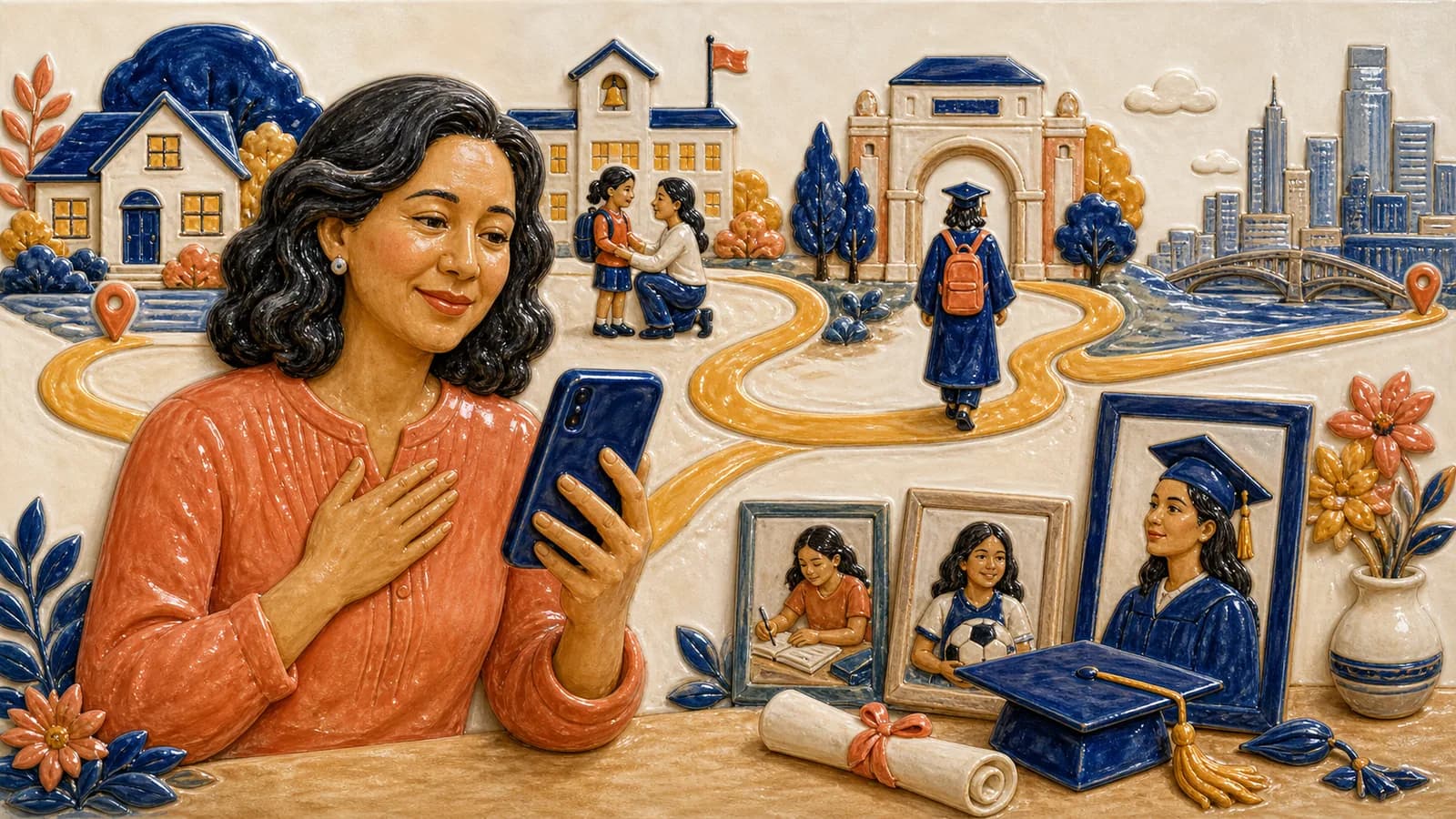
Most invitation cards ask for a photo, a clip, and a few words. Add one more line and ask for a place. It costs a contributor three seconds, and it changes what you can do with the finished video, because a first graduation is small and local, and the places are the ones a child already knows.
Put the request next to your media prompt so nobody has to hunt for it. One sentence is enough: "Tell us where your message was recorded — home, school, or somewhere they love." Keep it optional, the same way the rest of the card is optional, and accept a rough answer. A city is plenty; a full address is more than you need.
- Places worth asking for: the classroom
- the playground
- a grandparent's house
This is the part AlbumMap is built around. Every contribution can carry a location as well as its photo, clip, or message, and the finished video animates the journey between those places instead of cutting from one face to the next. For the class, that turns a stack of separate clips into one story with a shape — you can see who took part and how far the messages travelled. If you would rather keep it simple, you can skip locations entirely and export the same contributions as a straightforward slideshow.
Final Invitation Card Checklist
- The card clearly says it is for a kindergarten graduation video.
- The headline names a young graduate or small class.
- The request asks for one short submission.
- The time limit and due date are easy to see.
- This card offers two or three message prompts.
- The part link works on a phone without a special app.
- The card sender and privacy plan are named.
- The reminder plan is limited and respectful.
A clear contributor invitation makes the rest of the project easier. Contributors know what to do, submissions arrive in one place, and a young graduate or small class receives messages that feel personal rather than rushed.
Final Thoughts
The best invitation for a kindergarten graduation video is not the fanciest one. It is the invitation that helps a busy person understand the request and feel comfortable saying yes.
Use a playful, gentle, and very simple voice, show one next step, and respect every guest's time and privacy. Then keep this card, collection link, and follow-up messages consistent until the send-by date.
Helpful answers
Frequently asked questions
What should a kindergarten graduation video invitation card include?
Include the guest of honor's name, reason for the video, one clear clip request, suggested length, two or three prompts, due date, private submission link, and host contact.
When should I send the invitation for a kindergarten graduation video?
Send it early enough to allow one or two reminders and time for editing. For this project, a useful target is one week before the classroom celebration.
How long should each guest video be?
Ask for 20 to 45 seconds. A short limit feels easy and helps the video gift move at a comfortable pace.
What can someone send if they do not want to record video?
Offer a text response, audio note, or photo. These options make the invitation more accessible and can still add meaning to the final gift.
How many reminders should I send?
Send one follow-up message halfway to the due date and one near the end. Stop after a person submits or declines, and keep every follow-up message friendly and optional.